Masal, Where Are You?
In Emel Şimşir’s novel Kılıf, one question comes up again and again: “Masal, where are you?” As we read on, the question turns back to us: Where am I?
Emel and I crossed paths during lockdown, in “21 Gün Okuyanları” (the 21-Day Readers), the online reading group Serda Kranda and I set up. Later we wrote and talked together in various creative writing workshops at Serda Kranda Akademi. It was in those workshops that I first came to know her writing. Yet it turns out she already had a novel called Kapan, published in 2019. I confess I was not aware of it at the time.
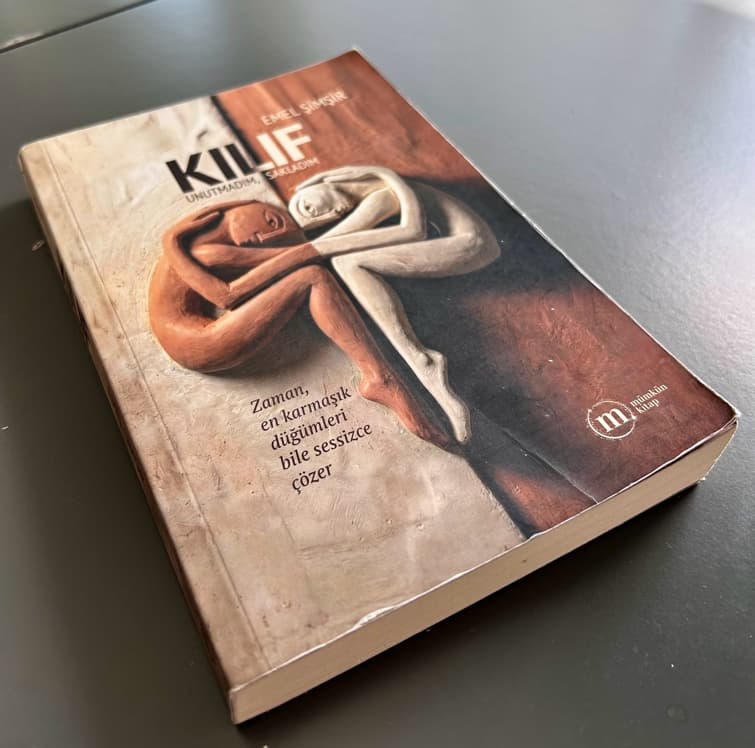
Then I learned she was writing a second novel. Kılıf, which I had been eagerly waiting for, was published by Mümkün Kitap a few months ago. I bought the book, and I went to the signing as well. As Emel signed my copy, the joy of bringing her new novel to its readers was written all over her face. Holding a new story by someone whose writing I knew was a pleasure all its own.
During the talk, when Serda said in passing, “I had thought people do not fall in love at 50,” my ears pricked up. So there was a woman in the story who was 50 and, what is more, in love.
For a long time now I have been thinking, writing and working on the second half of life. What happens to our lives after fifty? Do we live the years ahead as a continuation of the past, or do we stop at some point and take a fresh look at what comes next?
I started reading Kılıf with that curiosity.
Meeting Masal
Kılıf is an easy-to-read, flowing, enjoyable novel. The story’s main character is Masal.
First we meet the Masal of today. A famous husband, a comfortable life, a mother who makes her presence felt in almost every area of her life… Seen from the outside, the kind of life many people might wish for. Within this life, Masal wants to make more room for herself. She begins to think about the decisions she made years ago under the sway of her fears and her mother, about where she stands today, about what she left behind. Then a trace of her past appears in her path. An interview opens the door, just a crack, to the life she left years ago. It reminds her of her love, her sense of freedom, the things that thrilled her and the Masal she was back then. And with it come the questions.
What would have happened if she had chosen differently?
How would life have unfolded?
Who would today’s Masal be?
As you read Masal’s questions, you look at your own life too.
Masal, Where Are You?
There is a question that comes up again and again in the book:
“Masal, where are you?”
This question, which seemed quite ordinary at first, took on a different meaning for me as the story went on.
Where is Masal?
I do not mean where she is in a house, in a city, in a marriage.
Where is she in her own life?
Here I stopped reading for a little while. We work, we marry, we raise children, we take on responsibilities, we hurry to get where we need to be. We try to be a good mother, a good wife, a good employee, to stay strong, to succeed. Over time we come to have many roles in life. Then one day something can make us stop. A book, a person, a journey, a birthday, sometimes a single sentence…
This time the question turns back to us.
Where am I?
Our Covers
I loved the book’s title too. Kılıf.
A kılıf, a cover, protects. It wraps what is inside and hides it from whatever comes from outside. Over time it can also make what is inside harder to see. Jung came to mind, of course. Throughout life we have different faces, different roles. At home, at work, with our friends, different sides of us come to the fore. Every role we take on is ours. Over the years some of them fit us so well that it can become hard to tell where the role ends and where we ourselves begin.
Masal’s cover, too, has taken shape over the years. Fears, choices, expectations, relationships, comfort…
Perhaps that is why the question “Masal, where are you?” strikes such a chord with me. As we live, we add a great many things to ourselves. Experience, success, responsibility, relationships, titles, habits…
Every now and then, we need to turn round and hear the voice of the one inside as well.
Where am I?
If We Could Go Back to the Past
At some stage in life, I think most of us look back on the past. If there were a parallel universe and we could cross over, just for a short while, to the road we did not choose, what would it be like? What if I had decided differently that day? What if I had taken that job? What if I had gone to another city? What if I had tried instead of being afraid?
As we age, the forks in the road behind us can become more visible. We have no way of knowing what the life we did not choose would have been like. The life we have lived, though, is right here with us, with all that we have been through.
For me, this is where Kılıf moved beyond a story of going back to the past and opened onto somewhere else. Being curious about the past is one thing; wanting to live there is another. Perhaps the real question is not “What should I have done that day?”
“From where I am today, where do I want to go?”
Masal, too, pursues these questions. She looks at her past, comes face to face with her choices, asks herself questions. In the end she begins to redesign her life. One of the pleasures of the book is discovering alongside Masal what kind of path she follows, the surprises that come her way and the answers she gives to her own questions.
The thought that stayed with me while reading Kılıf, and after I finished it, was a little different. When I think about the second half of life, I do not dream of erasing the past or of going back to my youth. Everything we have lived through is held within who we are today. Our choices, our misjudgements, what we gave up, what we dared, our loves, our successes, our losses… It is all ours.
This is also, in part, what I love about Jung’s journey of individuation. Noticing again the parts of ourselves we left behind over time, bringing them together with who we are today and coming ever closer to ourselves. Perhaps this is one of the lovely things about ageing, too. Rather than trying to go back to who we were at twenty, we can set that twenty-year-old’s curiosity, courage and dreams side by side with the experience we have today.
When I finished reading Kılıf, Masal had set me thinking about my own life.
The pages of our life that we have already lived are part of our story. Ahead of us, though, are pages still waiting to be written.
I would say, read Kılıf. Out of curiosity about Masal’s story, of course. But also to close the book every now and then as you read, and look at yourself.
Ask yourself the same question that is put to Masal:
Where am I?
Then turn your face towards what comes next and add one more question:
Where do I want to go from here?
Related reading
Health
Look After Yourself in Autumn: What Does Our Body Need as the Season Changes?
The days are getting shorter, the air is cooling, the rains are starting. Perhaps autumn is asking us to change not only our wardrobe, but a little of the way we look after ourselves too.
September 30, 2026
Health
How Much Does Protein Matter for Ageing Well?
Protein is one of the shared needs of our muscles, our immune system, and even our ability to heal.
September 30, 2026
Health
Why Muscle Strength Is the Foundation of Ageing Well
Being able to walk, to climb stairs, to carry your own suitcase. Ageing well is usually this ordinary. On why muscle mass starts to fall from our thirties, what muscle memory actually means, and how to scatter movement through an ordinary day.
August 28, 2026